One year ago today I took delivery of, set up and then climbed onto my brand new Zwift Ride and had a brief ride to try it out. This was the second step of me turning my lifestyle around (the first being to change what I ate) and it kicked off a year of huge change for me.
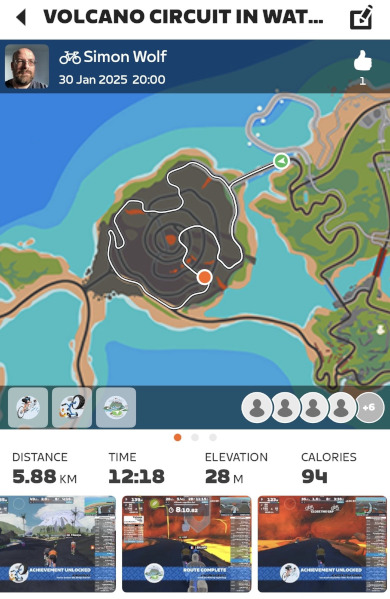
Over the last 12 months, as well as continuing to ride on Zwift (2,078 km ridden, 21 km climbed and 83 hours and 48 minutes spent doing it), I became a runner thanks to Couch To 5K and I now also do CrossFit twice a week.
I am now a lot fitter but, as I wrote back in November, one specific area I want to work on is my aerobic fitness and a VO2 max test will give me a good baseline to work from.
I also want to hit certain fitness goals in 2026 and they include running 5k in under 30 minutes and running 10k in under 60 minutes. Based on what my Garmin watch tells me (see below), I need to improve my lactate threshold to achieve that.
VO2 max
According to Wikipedia, “VO2 max is the maximum rate of oxygen consumption attainable during physical exertion.”
Essentially it is a measure of the maximum amount of oxygen your body can absorb and use during exercise. Oxygen is used to create energy called adenosine triphosphate (ATP) and the more oxygen you can absorb then the more ATP energy you can generate.
As well as being important for athletic performance, VO2 max is a way of determining cardiorespiratory fitness which is used to determine you heart and lung health. A higher VO2 max is associated with improved life expectancy.
Aerobic & Lactate Thresholds
As well as VO2 max, lactate levels are another useful metric to track. Lactate (or lactic acid) is produced and used by your body to break down carbohydrates for energy.
Below your Aerobic Threshold, called LT1, lactate production is balanced in terms of production and usage and your body is primarily oxidising fat as an energy source.
As activity intensity increases more lactate is produced and when it first starts to exceed the amount used you have reached the aerobic threshold. This is the upper limit of Zone 2.
The Lactate Threshold (LT2 and also called the anaerobic threshold) is when lactate levels start to increase significantly, leading to a noticeable net accumulation. This is the upper limit of Zone 4 and is what is also called Functional Threshold Power (FTP).
At this point, as well as lactate levels rapidly increasing in your blood, you are producing a high level of hydrogen ions which lower your blood’s pH level, making it more acidic. This is why lactate is also called lactic acid. And it is this increase in acidity reduces your muscles’ ability to contract, slowing you down.
Just to make things confusing, LT1 and LT2 are sometimes called the lactate threshold and the lactate turnpoint.
Training Theory
VO2 max can be improved by high-intensity interval training (HIIT). This is where you reach or temporarily surpass LT2 your anaerobic threshold before dropping below it again. This causes your heart and lungs to adapt and increasing their capacity and efficiency. It seems like CrossFit is a good activity for this.
To increase my lactate threshold there seem to be two main views. One is to train at a level where I am between LT1 and just beyond LT2. The other is to do up to 80% of training at a low intensity and around 20% at or above LT2. This is going to be best achieved by doing things like threshold runs, split threshold runs and progression runs.
And that 80% of low intensity running is where I can target zone 2 slow running. This is to help me increase my aerobic fitness and also to build my endurance so that I can more comfortably run 10k and beyond. Zone 2 training also increases the number and size of mitochondria in your cells which are the sites in the cells that create the ATP energy mentioned earlier.
Measuring VO2 max & Lactate Threshold
With the theory out of the way, having some actual values for my VO2 and lactate threshold will be useful.
My Garmin watch (a Fenix 7) gives me an idea of what it thinks my VO2 max is, both for cycling and running. It currently tells me that they are 44 and 41 respectively which just puts me into the “excellent” category for cycling and has me in the “good” category for running.
It would be more usual for someone to have a lower cycling VO2 max because you are largely using just your legs whereas in running you are using more muscles and generally putting your body under more strain. I think my readings are like this because I have tracked a lot more indoor cycling sessions than I have outdoor runs so my Garmin has more data to work with for cycling.
My watch also gives me an idea of what it simply calls my lactate threshold. It says I reach it at a heart rate of 168 bpm and a pace of 6:04 per km. That implies I can run a 5k in around 30m 20s so I am assuming that Garmin’s lactate threshold is LT2.
The lactate threshold estimate might be accurate since my 5k times are based on parkruns which tend to have slow, crowded starts or on the somewhat hilly lanes round my village. I need to find a nice flat, quiet course to see what my time is then).
But the most accurate approach is to go for a proper VO2 max test with lactate threshold testing being done at the same time. I am fortunate that the University of Bath is about half an hour away and offers this as a service. They can do testing with you on a bike or on a treadmill and since I want to focus on running more this year I opted to go for the treadmill test and that is what I did today at the cost of £180.
The Test Experience
My test was performed by Jonathan Robinson who, if you watch any of the Bath-based sports and fitness channels on YouTube such as Global Cycling Network, you might already have seen doing tests for them.
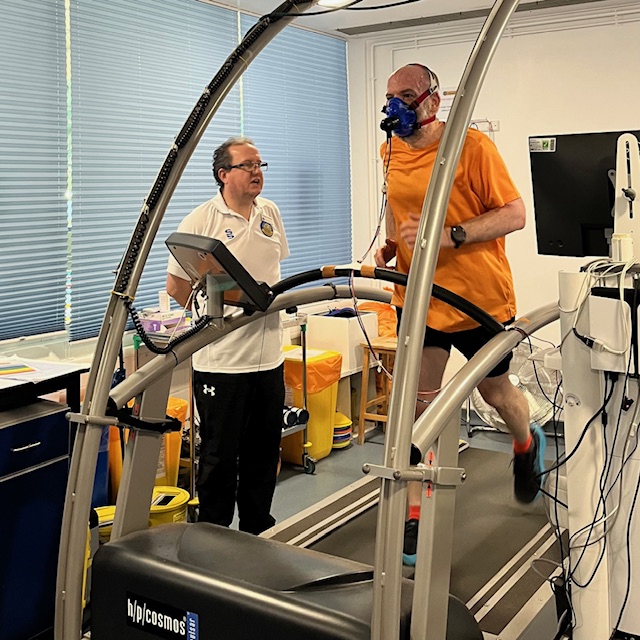
Jonathan talked me through the process and we did the obligatory paperwork and then it was time to have a face mask fitted which allows him to measure my oxygen intake and carbon dioxide production. After a warm up jog on the treadmill, we were ready to begin.
The testing process consists of completing three minute sessions of running where the pace increases by 1km/hour each time. I imagine that more advanced athletes might have larger jumps or, at the very least, start at a faster pace than I did.
Between each session a blood sample is taken via a finger prick (the same site is used for each test… you don’t come away with hands like pin cushions) and this is used to monitor your lactate levels.
And it all went very smoothly. Wearing a face mask is a bit odd but it is not overly restrictive (although I couldn’t wear my glasses comfortably). Jumping on and off the treadmill onto the side rails was a bit strange, particularly “rejoining” a moving treadmill, but nothing too difficult. And when I finally had to stop I just jumped onto the side rails and we were done.
Coming Soon - The Results
When the testing was over and I’d got my breath back we went through some of the results but I am going to wait until I get my official report (in about a week) before sharing them. This is partly to make sure that I get the figures right and partly so that I can read and digest the report to see what other useful information might be in it.
However, being as spoiler-light as I can be, my Garmin watch is not massively off in terms of VO2 accuracy so I didn’t get any nasty surprises.